Welcome to All About Wildlife

Latest New Bird(s): Little Bunting @ Forrest Farm NR


  Random Pictures  

  • Common Redstart
    Redstarts are immediately identifiable by their bright orange-red tails, which they often quiver. Breeding males look smart, with slate grey upper parts, black faces and wings, and an orange rump and chest. Females and young are duller. Redstarts 'bob' in a very robin-like manner, but spend little time at ground level. It is included on the Amber List as species with unfavourable conservation status in Europe where it is declining.
    Goldcliff NR
  • Harlequin Duck
    Description to come soon!
    WWT Arundel
  • Scarlet Tanager
    Description to come soon!
    USA
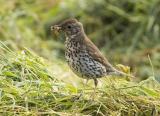
  • Song Thrush
    A familiar and popular garden songbird whose numbers are declining seriously, especially on farmland making it a Red List species. Smaller and browner than a mistle thrush with smaller spotting. Its habit of repeating song phrases distinguish it from singing blackbirds. It likes to eat snails which it breaks into by smashing them against a stone with a flick of the head.
    Schull, Ireland
  • Common Loons
    Also known in Europe as a Great Northern Diver.
    Minnesota, USA
  • Gannet
    Adults are large and bright white with black wingtips. They are distinctively shaped with a long neck and long pointed beak, long pointed tail, and long pointed wings. At sea they flap and then glide low over the water, often travelling in small groups. They feed by flying high and circling before plunging into the sea. It breeds in significant numbers at only a few localities and so is an Amber List species. Biggest mainland breeding colony at RSPB's Bempton Cliffs. Two mainland colonies - at Bempton and Troup Head, Scotland. Big island colonies on St Kilda, the Northern Isles and Bass Rock in Scotland and Grassholm in Wales.
    Ireland
  • Fieldfare
    The fieldfare is another well-known winter visitor to the UK.  They typically form large flocks, usually seen in the company of red-wings.  Sexes are similar.
    Cardiff
  • Atlantic Puffin
    Description to come soon!
    Skomer Island
  • Blue Jay
    Description to come soon!
    Minnesota, USA
  • Razorbill
    Description to come soon!
    Skomer Island
  • Bobolink
    Description to come soon!
    Crex Meadows NR, USA
  • Oystercatcher
    The Eurasian Oystercatcher, otherwise known as a Pied Oystercatcher or just Oystercatcher here in the UK is part of the oystercatcher family. Its the only one to occur here in the UK, although there are 3 subspecies of this oystercatcher in Europe and some of Asia. Its highly migratory but we are lucky enough to have this bird stay here year round. This bird as an adult has black above, white underneath, and a vividly red legs and bill which makes this striking bird really stand out amongst other waders. Despite its name, it does not primarily hunt for oysters, however its one of, if not the only wader to be able to pry open these tough creatures. What makes this bird really unique is that the shape of the bill varies depending on which type of food it specializes in. Birds that focus on molluscs have broad bill tips, where birds that specialize with unearthing worms tend to have pointed bills.
    Pagham Harbor
  • Eurasian Jay
    The Eurasian jay is a species of bird occurring over a vast region from Western Europe and north-west Africa to the Indian Subcontinent and further to the eastern seaboard of Asia and down into south-east Asia.
    Forest Farm NR
  • Moorhen - Juvenile
    Description to come soon!
    WWT Swansea
  • Curlew
    The Eurasian Curlew is the largest of all the waders in its range, at 50-57cm in height with a generous 1 meter wingspan. What makes this bird especially unique to Britain is that it’s one of the only places in Europe where it does not migrate, staying year round. In the winter they tend to gather in good-sized groups, though very wary of any disturbances. The only similar bird in its range is the Whimbrel, which is generally a smaller bird with a shorter, more downturned bill compared to the smooth downward curve of the curlew.This bird is mainly greyish brown, white on the back, and a very long curved bill.
    Pagham Harbour
  • Wheatear
    The wheatear is a small mainly ground-dwelling bird. It hops or runs on the ground. It is blue-grey above with black wings and white below with an orange flush to the breast. It has a black cheek. In flight it shows a white rump and a black 'T' shape on its tail. It is a summer visitor and passage migrant. Birds breed mainly in western and northern Britain and western Ireland, although smaller numbers do breed in southern and eastern England. It winters in central Africa.
    Skomer Island
  • Short-eared Owl
    Description to come soon!
    Pagham Harbor
  • Northern Cardinal
    Description to come soon!
    Minnesota, USA
  • Ruby-throated Hummingbird
    Description to come soon!
    Minnesota, USA
  • Whinchat
    Description to come soon!
    Pagham Harbor
See something you like? We don't currently advertise or actively promote any of our photos,
but if there's something you like then please contact us and we'll see if we can accommodate you!


Latest Updates
10-Oct-2015 New sort option "Date Added" now available to show latest additions. E.g. Birds
13-Jun-2015 Wildlife photos from our first visit to the Republic of Ireland added
03-Oct-2014 Blog replaced with Favourites page
01-Jan-2014 Visit to Forest Farm pics added
01-Jan-2014 Norfolk pics Added
01-Jan-2014 Minnesota 2013 pics Added
20-June-2013 Animals from Berwick upon Tweed & Scotland 2013 Trip Added
20-June-2013 Birds from Berwick upon Tweed & Scotland Trip Added
02-Apr-2013 Pagham Harbor 2013 Trip Added